Quilting Reviews
|
Quilting 101
Quilting 101
There are many decisions to be made before a quilting project begins. The first is choosing what design you will use. This choice may vary from project to project.
Traditional quilting involves following the outline of the block's design. You would stitch 1/4 inch from each seam line on your pieced or appliquéd patch. This would be just outside the pressed seam allowances.
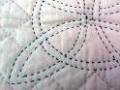
Stitching in the ditch is another quilting process. In this method you stitch right into the seam. The shape of the design becomes distinct and the stitches are almost invisible as the fabric on each side of the seam puffs up around them.
In Design quilting, you embellish your quilt block with a set design. You simply purchase a quilt stencil and trace onto your patch in any open spaces.
Echo design quilting is when lines of stitching follow the outline of the block, then are repeated every 1/4 inch. This repetition makes sections of very heavy quilting and is not practiced by beginners.
Overall design quilting ignores the block's pattern and uses an overall design. Three overall designs often used are grids of squares, diamonds and clamshells.
What quilting design you choose will also affect what pattern and fabrics you choose and vise versa. What you need to learn to do is visualize the completed project before you even begin. Obviously, if you want to use stencils and the design quilting method, you must choose fabric that has room for you to stencil on it.
Now that you have chosen you pattern, fabric and design you may begin piecing you quilt top. This involves creating a template, cutting all the pieces and sewing the blocks together. Once the blocks are completed they too must be connected to form the quilt top. You should first lay out all your blocks to make sure they are uniform in size, as well as in the correct position. Try not to place blocks that are too similar in design or color next to each other. Once you are satisfied with the design just divide the quilt into rows, either horizontal or vertical and begin sewing.
Once your quilt top is finished you are ready to layer it together with the batting in the middle and the backing fabric on the back. Polyester batting is the most popular and easy to use filling available today. All you have to do is open the bag and unroll it. This type of batting comes in different lofts or thicknesses, the thicker the loft, the warmer the quilt.
Backing fabric should have a low thread count and be loosely oven. The backing and the batting should be just slightly larger than the finished quilt top. Backing fabric usually needs to be seamed together. The traditional way is to seam three lengths of fabric, of equal widths, vertically down the backing. Cut off the selvage first, than shrink the fabric before you use it. Sew together the seams and press.
Place the backing on the floor, wrong side up. It should be about 2 inches larger than the quilt top. Roll out the batting. It should be cut about 1 inch smaller than the backing and one inch larger than the quilt top. Center the quilt top on top of the batting face-up. Pin all three layers together. Baste the layers together, beginning in the center of the quilt. You may use running stitches or Z stitches for basting.
If you are hand quilting your project you will require either a quilt frame, or a large hoop. Hoops are more portable, but require more basting. Once your project is secure you begin stitching the three layers together in very small uniform stitches, using the design you chose earlier. Start With about 18 inches of thread and begin working in the centre of your project, quilting toward the outside edge.
 |
 |
 |
How To Use Stencils For Quilting
Where To Find Free Quilt Patterns
The Best Quilting Pattern ForYour Needs
Making Sense OF Quilt Patterns
More Quilting Articles
... when you put it in your sewing machine. With the wide variety of quilting thread, and its relatively low cost, there's no reason not to just buy new thread when you need a different color. You'll save a fortune in frustration alone. Some manufacturers also produce special threads for embellishing, and ...
Where To Find Free Quilt Patterns
... traditional American quilts such as the Log Cabin, Hospitality Pineapple or Lone Star, holiday designs, designs with animals or flowers on them, and many, many more. There are even free quilt patterns for food and drink, nautical designs, or angels and butterflies. While many sites feature free quilt ...
... for cutting paper. Embroidery scissors are small, sharp and often decorative scissors that are used in quilting to cut thread and trim fabric. Pinking shears have serrated blades. They are used to create decorative edges and prevent fraying. Rotary cutters are used with a cutting mat. They are great for ...
How To Choose The Right Batting
... battings, whatever form you choose, are available either pre-cut or rolled on a tube so that you can cut your own to size. If your quilting project is a standard quilt size (such as twin, full, queen, or king) you will probably be able to find a pre-cut batting quite easily. For other sizes you may need ...

|
| Copyright © 2006-2012 Internet Marketing Tools, All Rights Reserved |